Intention
At Croft Primary School, we aim to create successful, fluent readers who will monitor their understanding of what they are reading, review the text when something does not make sense and, most importantly, love the art of reading. More than this, we want pupils to leave our school with a genuine love of reading that will stay with them their entire life. Throughout each over-arching theme, each class will use a key text to use across a variety of lessons to enhance their learning. During reading lessons, pupils are explicitly taught strands including vocabulary recognition/understanding, inference, retrieval, summarising, prediction and activating prior knowledge. The pupils use these strands to check how well they comprehend what they have read and overcome barriers to comprehension. These are adapted and scaffolded so that pupils build on their knowledge in each strand over time.
The approach
From Year 1 through to Year 6, pupils have weekly reading lessons as a whole class. These lessons:
- Are built around the teacher reading high-quality and challenging texts, which are dissected by the class through high-level questioning and discussion.
- Include a range of activities – not all of which must have a written outcome – that enable pupils to develop skills associated with being good readers (VIPERS). The benefits of this approach are that pupils are regularly immersed in high-quality children’s literature across different genres. Moreover, pupils will improve speaking and listening skills with a focus on being orally literate. Alongside this, pupils develop comprehension skills using VIPERS where progression is planned through each year group. Because of the style of the approach, more time is given to modelling skills rather than just assessing ability.
How does it work?
As a school we use Literacy Shed to aid our planning for our Whole Class Reading sessions. All texts are at a level beyond that at which the children can read independently. The Lesson Objective and VIPERS focus for the session is the same for all pupils in the group. Pupils will have access to the same activities and levels of questioning, but teaching will be adapted depending on pupil needs. The teacher reads the text to the class, modelling fluency, intonation and comprehension, and pupils follow the text with their own copy. The children will at times be asked to read parts of the text aloud to the class. The teacher plans and uses skilful questioning and discussion to help pupils get to grips with new vocabulary and develop their understanding of the text. Pupils work on activities that help them to develop their comprehension of the text.
Assessments
Headstart Assessments – Year 1,2, 3, 4 and 5 complete assessments using the HeadStart testing materials once a term for Reading. These tests are conducted in a supportive style so that children can achieve the best they can. This might include smaller groups, small breaks throughout and adult scribing where appropriate. Once these are completed, Class Teachers then complete Question-Level Analysis for each child to identify individual gaps in knowledge as well as more broader class trends. This then informs whole class teaching for the subsequent term as well as individual interventions for children.
SATS Assessments – All children in Year 6 will complete the Statutory Assessments in Summer term in accordance with the Department of Education. This then gives the school data to track progress and overall attainment. To familiarise children with this process and to give Year 6 Class Teachers an accurate picture of current attainment, children will complete past SATs papers throughout Year 6. Like HeadStart, once these are completed, Class Teachers then complete Question-Level Analysis for each child to identify individual gaps in knowledge as well as more broader class trends. This then informs whole class teaching for the subsequent term as well as individual interventions for children.
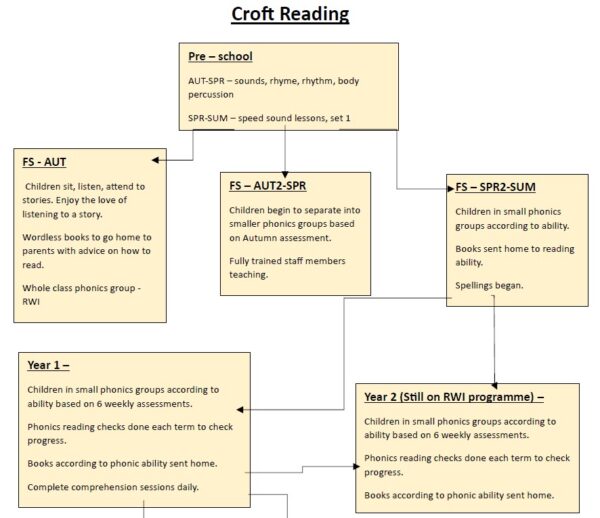
2Eskimo Reading Assessments – These assessments are designed to ensure that all children who have completed the Read Write Inc programme of study are reading the correct level of reading book based on their reading fluency and word recognition. They are carried out every term with most children and more regularly with targeted children. Based on the results of these assessments, children are then given a certain colour book band and can choose a text within this range.
Research shows the importance of early reading in the development of children and the link between this and academic success and we recognise that to maximise this we need a strong relationship with our parents in regards to reading.
Parents are invited into school for a discussion with the reading lead twice a year. Reading and Phonics will lead this discussion. Parents will learn how their child learns phonics and reading and will discuss ways they can support their child at home with their learning.
During parents evenings Pupil progress in school will be discussed and parent’s will be asked about engagement with reading at home. If appropriate, teachers will discuss the amount of reading that is being completed at home and offer support about how school can help should this be below what is needed. Parents will also be informed about their child’s current level of attainment and the amount of progress made since the start of the academic year. A target will be set for reading along with some steps to be completed at home to ensure that the child is successful with this target for children in Years 1 to 6.
Weekly reading at home – We ask our children to read a minimum of 3 times a week at home to an adult, and have their reading diary signed with the book they read, the pages and a parent comment if appropriate. However, we actively push for as much reading to be done at home and stress that 3 is only the MINIMUM! Parents of any child not engaging with reading at home according to the lack of signatures in their diaries receive a check-in from the Class Teacher in a supportive manner. They are asked if there is anything school can do to help them be successful. These children are then monitored over the next half term by the Class Teacher, and, if appropriate, targeted for interventions. If this lack of reading continues to persist, Class Teachers will then refer it to the English Lead.
VOLUNTEERS – We have several volunteers in school weekly to read with the children in Key stage 1 and 2. They concentrate initially on those who don’t read as often at home and our bottom 20% attainers. They will ask them questions and engage them about what they have read.
Reading books sent home – Ensuring that children have access to high-quality texts at their level is vital for their reading to improve. EYFS/Key Stage 1 – All children in EYFS and Year 1 and those who have not yet passed their phonics screening check have a Read, Write Inc phonics book and a book bag book to match. These books include sounds and words that the children can read successfully. Children in Key stage 2 and those in Year 2 who have passed their Phonics Screening will have a reading book that links to their current reading level. All children have the opportunity to take an extra book home from our Library that they can share with parents at home and have the Library Van once a month to choose a book to take home and can then read this book to or with their parents. The colour bands that the children are on is based on their 2Eskimo assessment. These bands will change over the course of Key Stage 1/2 as the children’s reading abilities advance.
School Library – We are very fortunate to have a space for our school library, which has thousands of books in it at various levels. We aim to restock and continually update each year through purchases made by the school and through kind donations from parents and publishers. All children have access to the library with class staff and will change their Library books weekly.
We are also very fortunate to have the Library Van visit the school monthly, where the children will choose a new book each time to go home with.
Reading displays – Reading displays feature in each classroom from EYFS to Year 6. Many classrooms feature the books the class have read, what they are currently reading (this may be displayed on the classroom door), VIPERS displays and other exciting ways to get children engaged in different texts.
World Book Day – Each year, we ensure that we celebrate our love of reading on World Book Day. Teachers plan different reading themed activities, teachers share their favourite stories with the children and the children can dress up as their favourite book characters if they choose. It is our belief that reading should be celebrated every day, but it is nice to have one day dedicated to the joy of reading as well.
Scholastic Book Fair – Each year, we host a book fair where children have the opportunity to buy from a selection of books from the publisher Scholastic. The added benefit of this is that the school also receives a proportion of the money spent which we use towards buying books for our school library.
Book Fest – Once a term we ask all the staff members to choose their favourite picture story book based on a theme (eg. Christmas). The children choose which story they would like to listen to and then on the day they are told who will be reading the story to them. The children will be taken to different places around the school to listen to their story.
Theatre Performances – All children have the opportunity to experience theatre performances. In previous years these have consisted of companies coming to visit us at school.